Architecture
In the end, web applications all have the same basic needs. Of course, it needs to be adapted for the needs of the application, however it is assumed as a common base for all the following infrastructure.
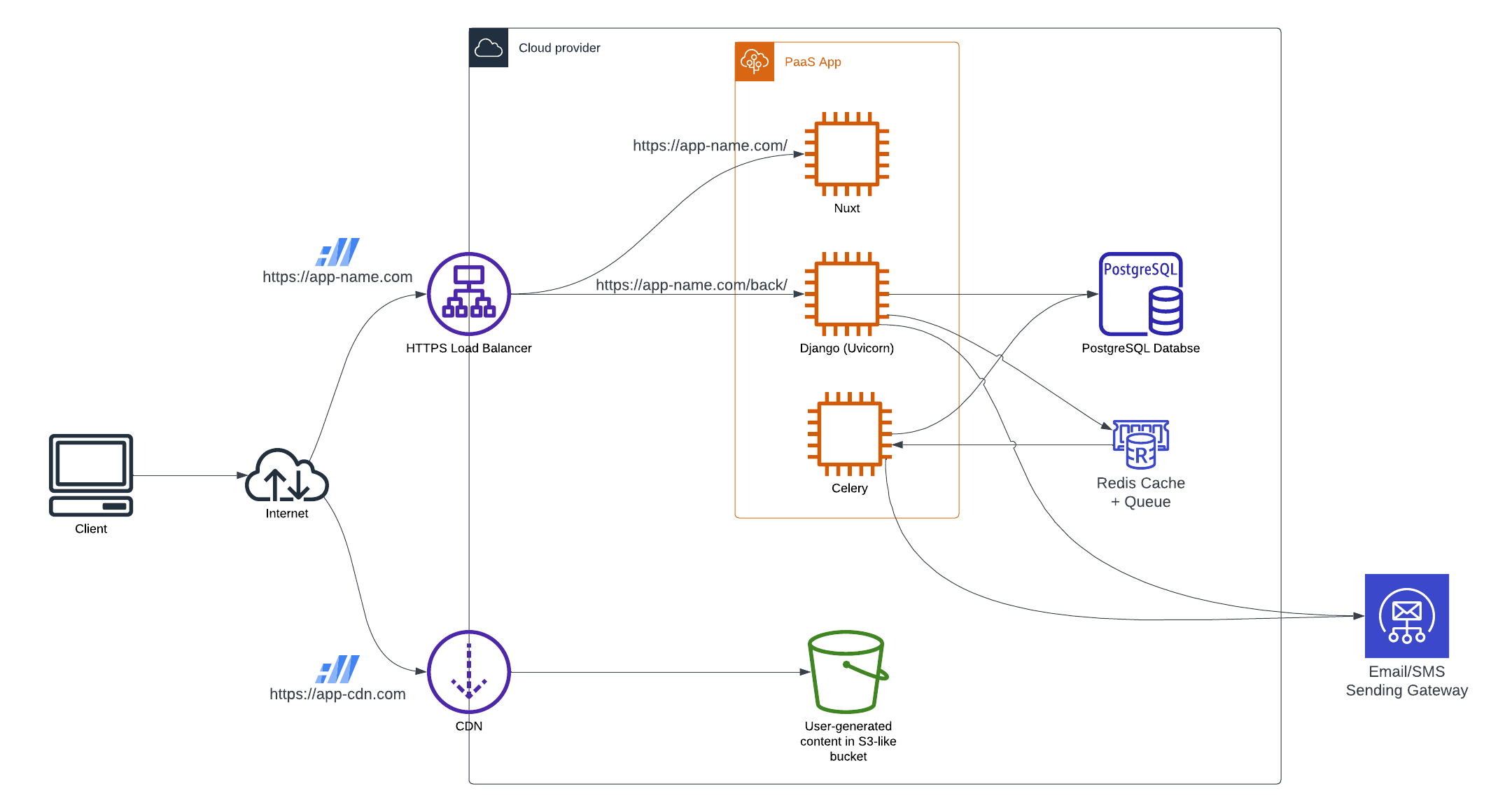
We’ll explain the rationale behind main choices here.
Framework stack
Since the requirements explained here stem from the choice of frameworks, we’ll dive first into those.
Back-end — Django
At the core of the core lies Django. It’s a fairly old, slow and un-sexy framework in today’s world full of revolutionary async noSQL blazing-fast world-class industry-standard frameworks. How did we land there? There are the 3 main features of Django (for our use case):
The ORM
The ORM
The ORM
We’ll cover the choice of SQL and PostgreSQL later on, but the fact that Django has such a powerful ORM enables several productivity boosts:
The ORM has a Git-friendly migrations system
Most of the time, this allows for zero-downtime deployments (worst-case scenario, some requests fail, but if the app is well done the consequences are very small)
The migrations can be merged between branches, allowing for teamwork and complex release cycles that match real-life requirements
It allows easy introspection of models
The
adminapp can auto-generate full CRUD admin interfaces within minutes of work, which saved our ass so many timesThe Django REST Framework can lay the base of the API by simply looking at models (then it’s up to you to add the specific behaviors you need, but a lot of work is done automatically)
Any alternative framework should at least offer the same guarantees. So far, none really exist as such on the market and Django is entirely satisfying, so we stick with it.
Then it has many perks about security, abstractions for common services (storage, emails, etc), internationalisation and localization, etc. Those are important albeit secondary.
Front-end — Nuxt
The underlying choice is: which JS framework to use? It wasn’t always obvious, but some of the key names are React, Vue, Angular and Svelte. Out of those, we want to eliminate those that are not actually reactive (React) and those that are made for “enterprise” development (Angular). This leaves us with Vue and Svelte.
Out of those two, we need a SSR framework that will handle under the hood many things that developers don’t even realize anymore: data store, meta data of the page, HTTP requests, etc.
Because of pure timing reasons (the choice of this stack happened around 2017) Vue 2 is still in use and thus Nuxt 2 comes with it.
Now there might be in the future a switch to Svelte Kit, but the switch to Vue 3/Nuxt 3 presents equivalents benefits while being probably easier so it’s actually very likely that the future will be Nuxt 3.
Storage
Django and Nuxt both depend on external services for persistence. Those services must come from the cloud provider, as they are a massive pain in the ass to manage yourself. Commonly considered providers in our case include DigitalOcean, AWS, Scaleway and OVH.
Structured data — PostgreSQL
As explained before, we store most of structured data in a PostgreSQL database. This is because:
It is extremely viable:
It has a great output performance-wise. Most of the time when a NoSQL solution claims to be faster it is because it forgoes “slow” features of SQL like joints, which are absolutely essential for most applications. In other words, SQL storage allows you to do the same as NoSQL but comes with a lot more features.
Clustering and scaling and so forth is pretty hard to do yourself, but why would we care since it’s the job of the cloud provider.
If a product is so successful that it brings a PostgreSQL instances to its knees, we’ll have plenty of resources to optimize SQL queries, shard the data and so forth.
If you need to do some NoSQL things like storing JSON, PostgreSQL has very powerful JSON management, allows indexing and querying of JSON and the query language is Turing-complete with recursive queries. You can query a lot of things.
And finally, the PostGIS extension for geographical data is available in all providers and is extremely powerful in managing geo queries.
It has fantastic support in the Django ORM
This overall makes it the best choice for structured data storage.
Cache — Redis
Redis is very fast, very easy to manage and available in all cloud providers. That’s also a solution that is natively supported by Django, which makes it a good choice for our stack.
Queue — Also Redis
Natively Celery would rather use RabbitMQ, which is also a trustable piece of software. However the availability of RabbitMQ in various cloud providers is quite reduced.
On the other hand, Redis provides a good option and works perfectly well. So that’s what we’ll go with.
User-generated content — S3-like
Everything that is user-generated (images mostly, but also PDF documents, videos and so forth) should be stored in a S3-like bucket. It’s easy to use, there are the right abstractions in Django and it’s available everywhere.
Given also that the original S3 remains unequaled in feature-completeness, it is a service easily bought from AWS even if the rest of the infrastructure is on a different provider.
External communications
The stack above will require to be able to send emails and/or SMS to clients.
In order to do so, the abstraction to be used is the
Wailer system, which provides a
higher-level abstraction than the Django email backend (or the django-sms
package, which it uses internally).
The goal of Wailer is to enforce patterns and best practices for sending emails which are convenient for the developers and avoid the common bugs by asking the right questions.
It still needs a backing service to send its messages. The recommended one for both emails and SMSes is Mailjet. Its configuration is explained in the Django preset documentation.
PaaS platform
It’s expected that the app code will run in a PaaS platform, or at least some kind of orchestrator like Kubernetes. There should be 3 basic services (conceptually, in practice there are more):
Nuxt for the front-end
Django (through Uvicorn) for the back-end
Celery for the Django tasks
Those 3 parts are expected to be distributed as some form of images that respect the 12 factors and can be span as needed.
The PaaS platform should be provided by the cloud provider. To be honest, the target here is mainly the PaaS from DigitalOcean, which is by far the simplest one to manipulate.
HTTP Routing
HTTP routing can be a complex topic, however our recommendation goes as follows.
There shall be two “endpoints”:
A load balancer for all the processes of the PaaS
A CDN for the UGC and other content from the bucket
Both should be on separate domains for security and simplicity reasons. The source needs to be found back but basically it was an advice from a Google Engineering blog post. On top of that, the requirements are quite different.
The load-balancer’s job will be to direct HTTP requests either to the back-end
or the front-end. The easiest way to do this is to decide that everything that
is below the /back path goes to the back-end while the rest goes to the
front-end. Then both receive unmodified queries and can reply to the user while
keeping it transparent for the browser. This is especially important for the
cookies, which would be hard to manage if requests weren’t made to the same
domain for front and back.
This way when you request:
https://my-app.com/yoloyou get the front-end page “Yolo”https://my-app.com/back/api/thing/42/you get the “thing” with ID 42 from APIhttps://my-app.com/back/api/login/you login against the back-end and this cookie will be forwarded to any page within this domainMeaning that if you go back to
https://my-app.com/yoloand you render it server-side, it will still receive the session cookie, allowing to forward it to back-end requests from the frontend (which Nuxt/Axios does automatically)
Then for user-generated content, which is inherently static, it makes more sense to have a CDN in front of the bucket that will cache and serve this content on edge.
Repo structure
The rule of thumb is that all which is shipped together should sit in the same repo. Otherwise, you just end up doing the same conceptual commit in all the different components of the app. Let’s just acknowledge that we work with monoliths!
At the root of the repo should be found the different components:
api— The Django backendfront— The Nuxt front-endbot— The BERNARD project (if any)Any other component that you need
API
The API should follow the API template.
Amongst many things:
Configuration comes 100% from environment variables
The project depends on the
modelw-preset-djangopackage at the current Model W version
See the Transform an Existing Project section for more details.
Front
Same as the API, it should follow the front template.
The same rules apply, except that since it’s Nuxt 2 and we’ll move to Nuxt 3 there has not been the same effort put into providing a good preset. However, the template gives a good starting point and the the Transform an Existing Project section provides with more insights.
Extra
While the stack is explained above, some peripheral tools deserve to be mentioned below.
Sentry
Sentry is a powerful exception reporting tool. It will let you aggregate:
Different exceptions with a lot of details as to which user had it, on which environment, how many times, etc
Detailed performance metrics including the list of SQL queries and their specific run time
Overall, that’s the first tool to look into for insights about any project.